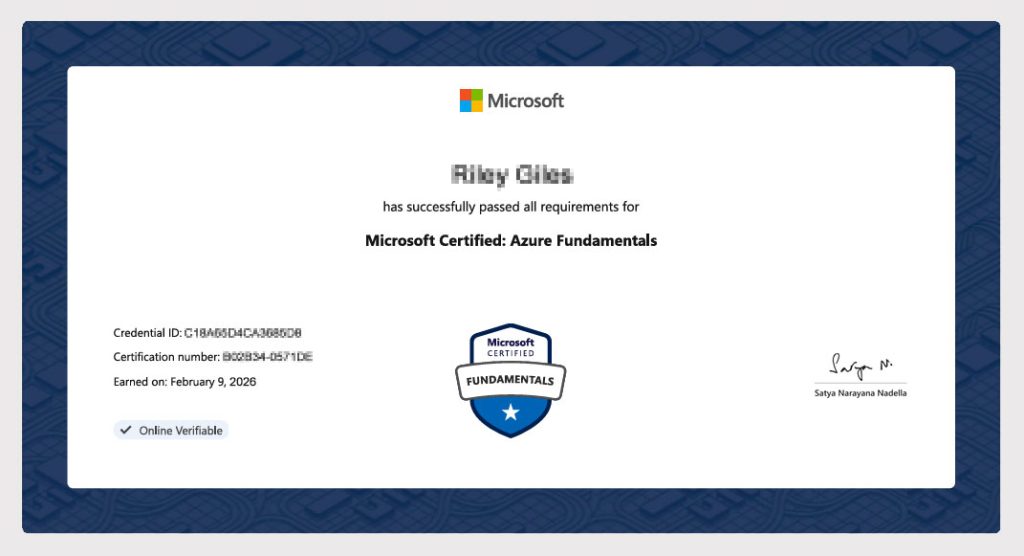
I passed AZ-900 in 2026, expecting it to unlock doors and land me a solid cloud role. It didn’t. I had the certificate, the “proof” of Azure fundamentals, but employers weren’t impressed. The reality hit harder than I imagined: passing an entry-level exam doesn’t automatically translate into a job offer.
Why I Chose AZ-900
Career Entry and Beginner-Friendly Appeal
When I first explored the cloud, AZ-900 felt like the perfect starting point. It promised a gentle introduction to Azure fundamentals, accessible for someone like me with minimal hands-on experience. Microsoft’s marketing and countless online forums reinforced the idea:”Get certified, get hired.” For many aspiring cloud professionals, it’s tempting to believe that checking the certification box guarantees career advancement. I wasn’t an exception.
Expectations vs Reality
Before taking the exam, I had a clear vision. I imagined recruiters reaching out within weeks, LinkedIn notifications buzzing with job interviews, and my resume instantly standing out. The exam itself wasn’t difficult; conceptually, it covered cloud concepts, core services, security basics, and pricing models. But post-exam reality was starkly different. Despite scoring well and updating my LinkedIn profile, responses from employers were lukewarm at best.
Common Market Beliefs About Certifications
The industry narrative suggests that certifications validate knowledge, signaling to employers that candidates are serious and technically competent. While this isn’t entirely false, in 2026, the perception has shifted. Certifications like AZ-900 are no longer differentiators. Instead, they’ve become a baseline expectation, something hiring managers assume candidates already know.
The Real Problem in 2026
AZ-900 as Foundational Knowledge Only
AZ-900 is a knowledge assessment, not a skills demonstration. It tells employers you understand Azure concepts, but it doesn’t prove you can deploy, troubleshoot, or optimize real-world cloud environments. Think of it like earning a driver’s license without ever driving in traffic: you know the rules, but you haven’t applied them practically.
Employer Priorities Today
Hands-On Azure Experience
Employers increasingly seek candidates who have practical experience, not just theoretical knowledge. They want people who can navigate the Azure portal, deploy virtual machines, manage network security groups, and troubleshoot live issues. Certifications alone rarely convey this.
Role-Based Certifications
Entry-level certifications like AZ-900 are often considered the first step, but the real job leverage comes from role-specific credentials. AZ-104 (Azure Administrator), SC-900 (Security Fundamentals), and AI-900 (AI Fundamentals Retires on June 30, 2026.Replacement exam AI-901) signal a candidate’s readiness to handle concrete responsibilities.
Portfolios Over Certifications
Many companies now prioritize proof of work: GitHub repositories, lab projects, or contributions to open-source cloud initiatives. A candidate who can demonstrate solving actual problems is far more compelling than one who simply passed an exam.
AI Transformation and Cloud Roles
The rise of AI-driven tools and automation in cloud computing is reshaping the landscape. Routine Azure tasks are increasingly automated, reducing the hiring emphasis on foundational knowledge. Employers now evaluate candidates based on problem-solving ability, cloud architecture understanding, and automation skills rather than basic certification scores.
Certification Saturation and Baseline Expectations
In 2026, the market is saturated with entry-level certification holders. AZ-900, once considered impressive, is now assumed knowledge. The real challenge is standing out in a sea of candidates who all tick the same box. Without additional qualifications or hands-on experience, the certificate alone rarely moves the needle.
What Actually Works Instead
Positioning AZ-900 Correctly
AZ-900 is a starting point, not a career accelerator. Think of it as a foundation: necessary but insufficient for building a career. It establishes your understanding, but you need to layer skills and experience on top. Treat it as a stepping stone, not a ticket to your first cloud role.
Real Career Progression Paths
AZ-104 Administration Path
After AZ-900, AZ-104 positions you as an Azure Administrator, validating hands-on skills with compute, storage, networking, and identity management. This credential aligns directly with job requirements and is much more likely to impress hiring managers.
SC-900 Security Fundamentals
For those interested in cloud security, SC-900 emphasizes security, compliance, and identity principles. Security-focused roles increasingly demand practical exposure, making this a strategic next step after foundational certification.
AI-900 AI Fundamentals
AI integration in cloud platforms is growing exponentially. AI-900 provides insight into AI and machine learning basics, helping candidates understand Azure AI services. Combining AZ-900 with AI-900 positions you as someone ready for emerging cloud roles.
Importance of Hands-On Labs and Projects
No certification can replace practical exposure. Hands-on labs, sandbox environments, and personal cloud projects give you experience with real Azure scenarios. They build confidence, develop troubleshooting skills, and create evidence of capability for interviews.
Building a Portfolio and GitHub Presence
Recruiters increasingly evaluate tangible outcomes. Document your labs, scripts, and mini-projects on GitHub. A strong portfolio demonstrates initiative and proficiency far more convincingly than a certificate alone.
Structured Practice Resources
Many learners use structured resources like leads4pass to prepare efficiently. While I don’t endorse shortcuts, structured practice exams help reinforce exam concepts and identify weak areas, making your certification study time more productive.
👉 https://www.leads4pass.com/az-900.html
Internal Knowledge Network
Microsoft Certification Roadmap
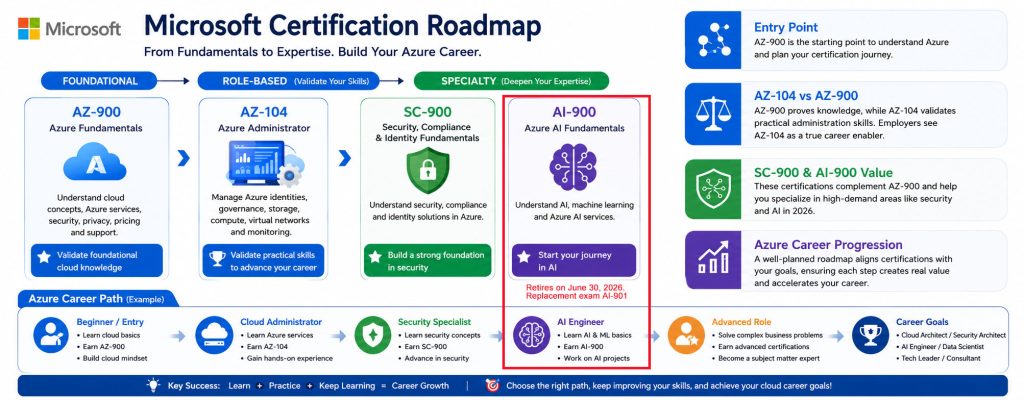
Within the broader Microsoft certification ecosystem, AZ-900 serves as the entry node. Understanding the roadmap helps plan career progression, from fundamentals to role-based and specialty certifications.
AZ-104 vs AZ-900 Comparison
While AZ-900 proves knowledge, AZ-104 validates practical administration skills. Employers often view AZ-104 as a true career enabler, whereas AZ-900 is merely expected.
SC-900 and AI-900 Connections
These certifications complement AZ-900, enabling specialization in security or AI, which are high-demand areas in 2026. Combining these credentials with hands-on projects multiplies career prospects.
Azure Career Path Progression
A well-thought-out roadmap helps candidates align certifications with career goals, ensuring each step adds real value, rather than just ticking boxes.
Future Perspective
AI-First Ecosystem and Certification Evolution
Microsoft certifications are evolving alongside AI-first strategies. Entry-level exams like AZ-900 are being reframed as literacy checks, while higher-value certifications focus on automation, AI integration, and complex problem-solving.
Entry-Level Certifications as Baseline Literacy
In 2026, passing AZ-900 signals that you have baseline knowledge. It no longer distinguishes candidates, so skill demonstration becomes essential.
Skills + Portfolio-Based Hiring
Companies are increasingly hiring based on proof of capability. Candidates with a portfolio of real projects, GitHub contributions, and practical experience have an edge over those relying solely on certificates.
Real-World Scenarios Over Theory
Understanding cloud theory is no longer sufficient. Candidates who can deploy multi-tier applications, automate workflows, and troubleshoot live systems are in high demand.
Certification Inflation and Market Saturation
The abundance of entry-level certifications has reduced their impact. Career progression now depends on combining certifications with experience, creating a distinct professional profile.
Conclusion
Passing AZ-900 in 2026 taught me a hard lesson: certifications alone don’t guarantee employment. They’re valuable for knowledge and foundational understanding, but employers seek applied skills, hands-on experience, and tangible proof of capability. The future of cloud careers lies in combining certifications with real-world projects, specialized credentials, and a strong portfolio. AZ-900 is the beginning of the journey—not the destination.