The Cisco 300-420 ENSLD exam in 2025 has evolved beyond the traditional “design-only” format. Cisco now emphasizes real enterprise architecture, zero-trust models, automation-ready topologies, and hybrid cloud networks. Because the exam content continues to shift toward real-world scenarios, outdated study materials can directly reduce your passing chances.
If you are preparing for the 300-420 exam, you must rely on materials aligned with the latest 2025 updates. Many old guides do not match the current blueprint structure, and relying on them will slow down your progress.
Understanding the Current Cisco 300-420 ENSLD Exam Structure
The Role of Cisco 300-420 in Enterprise Architecture
The 300-420 exam is part of the CCNP Enterprise track, focusing on network architecture planning, hierarchical design, routing strategy, SD-WAN, VPN, QoS, security, and automation.
Overview of the Updated 2025 300-420 ENSLD Blueprint
The 2025 blueprint highlights:
- Scalable enterprise architecture
- Hybrid and multi-cloud connectivity
- Automation and programmability
- Embedded security in design
These updates align with enterprise migration toward cloud-driven and AI-assisted networks.
Relationship Between ENSLD, ENCOR, and CCNP Enterprise
To earn the CCNP Enterprise certification, candidates must pass both 350-401 ENCOR (core exam) and a concentration exam such as 300-420 ENSLD.
What’s New in the Latest Official Cisco 300-420 Exam Information
Key Changes in the Latest Cisco Blueprint
Since late 2024, Cisco expanded automation, telemetry, and fabric design topics, making ENSLD more aligned with modern network ecosystems.
Exam Question Trends: Greater Focus on Real Enterprise Scenarios
Recent ENSLD questions frequently include:
- Multi-site enterprise architectures
- Zero-trust design
- Cloud-network integration
- Comparison-based scenario questions
These reflect daily responsibilities of enterprise architects.
Recommended Official References
Candidates can refer to the official Cisco blueprint as well as curated learning pages such as:
300-420 ENSLD Learning Resources (https://www.leads4pass.com/300-420.html)
This type of structured content helps visualize exam domains more clearly, but all information should still be validated against Cisco’s official material.
Most Practical 300-420 ENSLD Study Content for 2025
Core Technologies You Must Master
- Multi-domain enterprise architecture
- Enterprise edge design
- SD-WAN overlay/underlay
- BGP policy and path control
- Enterprise security integration
These skills match both exam domains and real industry requirements.
Seven Most Tested Enterprise Architecture Scenarios
- Multi-branch architecture
- Hybrid cloud connectivity
- BGP policy tiers
- SD-WAN resiliency design
- VPN technology selection
- Trusted boundary design
- QoS classification and bandwidth planning
Connecting Exam Topics with Real Deployment Experience
ENSLD mirrors real enterprise projects. For example, SD-WAN application-recognition design questions reflect real-world performance optimization challenges that businesses face today.
Where to Access Continuously Updated 300-420 Study Materials
Official Resources
Cisco documentation, Cisco Press books, and CLN modules remain the most authoritative references.
Community Resources
Communities such as Cisco Learning Network and networking forums help broaden understanding, though they should not replace official study.
Naturally Integrated Study Guide Recommendation
Candidates may also explore curated exam content for structured domain review:
Latest 300-420 ENSLD Study Guide
Always verify consistency with the latest official blueprint.
Latest 300-420 ENSLD Exam Questions and Answers
| Number of exam questions | Compelet Study Materials |
| 15 (Free share) | 395 Q&A (PDF | VCE) |
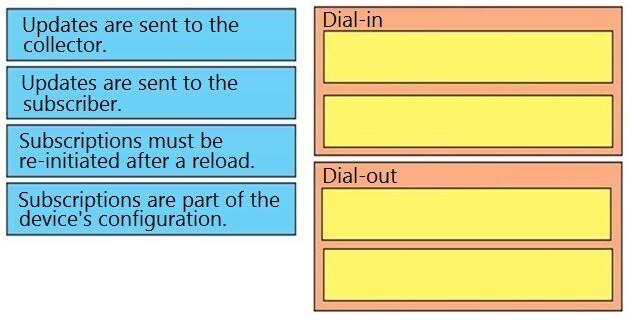
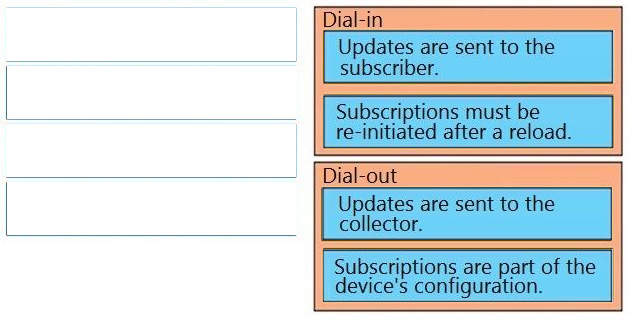
Question 1:
DRAG DROP
Drag and drop the model driven telemetry characteristics from the left onto the mode they belong to on the right.
Select and Place:
Correct Answer:
Question 2:
Refer to the exhibit An engineer working for a telecommunication company with an employee ID 4449:30 959 Is calculating STP scalability for switches to ensure that the numbers are below the maximum supported value for STP logical ports
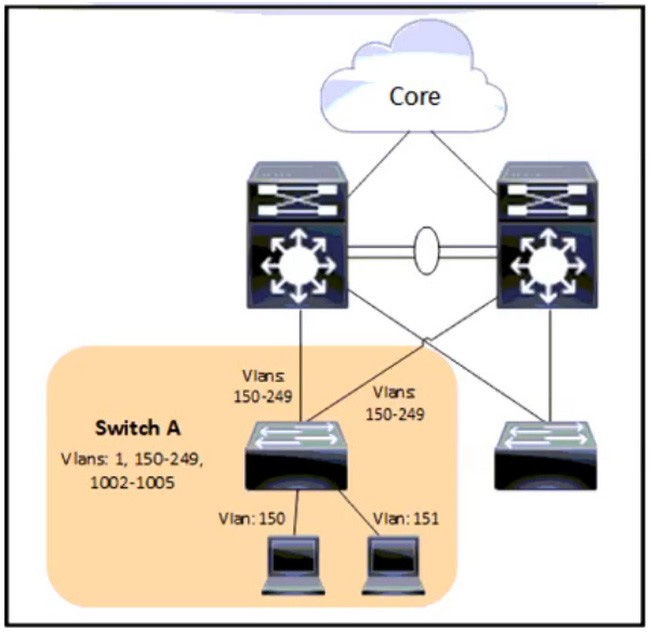
How many logical interfaces are active for switch A?
A. 4
B. 307
C. 202
D. 100
Correct Answer: C
Question 3:
An engineer must peer with an ISP for internet connectivity using BGP, initially, the engineer wants to receive only specific prefixes from the ISP and a default route. However, the solution must provide the flexibility to add prefixes in the future at short notice. The ISP has a two-week change process in place. Which route filtering solution must the engineer employ?
A. Request a limited internet routing table and a default route from the ISP and configure the BGP max-limit to 1 with an access list that permits only the specific internet prefixes and blocked networks
B. Request only the required prefixes and default route be advertised from the ISO with whitelisted networks
C. Request a full internet routing table and a default route from the ISP and configure inbound route filtering with a prefix list that permits the default route and required prefixes
D. Configure outbound route filtering on the enterprise and ISP so that the enterprise tell the ISP which prefixes are required
Correct Answer: C
Explanation: anychange on the prefix list, engineer only need to update the preifx list and restart the BGP peer to the ISP. soft-reconfiguration inbound could be used to reduce down time of reset BGP peer, but it require lots of memory and in this case, connection to ISP and tons of route learnt will not be apporitated.
Question 4:
Which are two advantages of a “one switch at a time” approach to integrating SD-Access into an existing brown field environment? (Choose two.)
A. appropriate for campus and remote site environments
B. allows simplified roll back
C. involves the least risk of all approaches
D. opens up many new design and deployment opportunities
E. ideal for protecting recent investments while upgrading legacy hardware
F. allows simplified testing prior to cutover
Correct Answer: AE
Question 5:
When designing interdomain multicast, which two protocols are deployed to achieve communication between multicast sources and receivers? (Choose two.)
A. IGMPv2
B. BIDIR-PIM
C. MP-BGP
D. MSDP
E. MLD
Correct Answer: CD
Question 6:
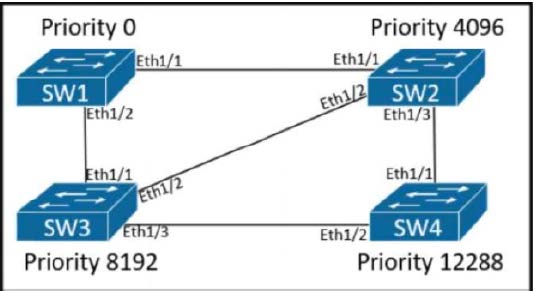
Refer to the exhibit. An engineer proposed this solution for a company that requires a loop-free, Layer 2 network design. The network will run 802.1w, and all links will be 1 Gbps. If all interfaces are up as point-to-point adjacencies, what are the expected port end states based on the design?
A. Eth1/2 on SW3 and SW4 will be in an Altn BLK state
B. Eth1/3 on SW2 and SW3 will be in an Altn BLK state
C. Eth1/2 on SW2 and SW3 will be in a Desg FWD state
D. Eth1/1 on SW1 and SW2 will be in a Root FWD state
Correct Answer: A
Question 7:
An engineer must design a multicast network for a financial application. Most of the multicast sources also receive multicast traffic (many-to-many deployment model). To better scale routing tables, the design must not use source trees. Which multicast protocol satisfies these requirements?
A. PIM-SSM
B. PIM-SM
C. MSDP
D. BIDIR-PIM
Correct Answer: D
Bidir-PIM is designed to be used for many-to-many applications within individual PIM domains. Multicast groups in bidirectional PIM mode can scale to an arbitrary number of sources without incurring overhead due to the number of sources.
Question 8:
Which type of rendezvous point deployment is standards-based and supports dynamic RP discovery?
A. bootstrap router
B. Anycast-RP
C. Auto-RP
D. static RP
Correct Answer: A
Question 9:
DRAG DROP
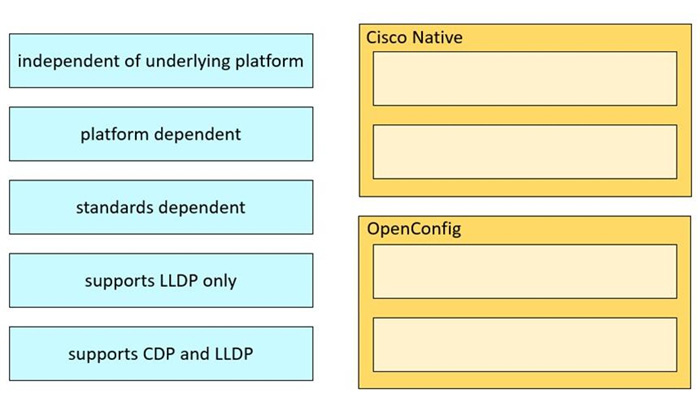
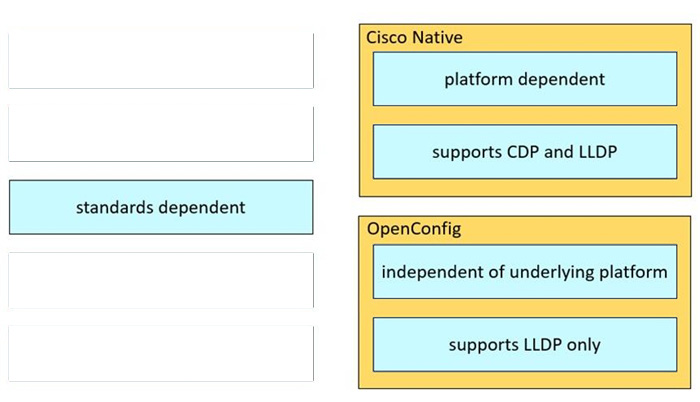
Drag and drop the characteristics from the left onto the YANG models they describe on the right. Not all options are used.
Select and Place:
Correct Answer:
Question 10:
What is one function of the vSmart controller in an SD-WAN deployment?
A. orchestrates vEdge and cEdge connectivity
B. responsible for the centralized control plane of the SD-WAN network
C. provides centralized network management and a GUI to monitor and operate the SD-WAN overlay
D. provides a data-plane at branch offices to pass traffic through the SD-WAN network
Correct Answer: B
Question 11:
An engineer must design an in-band management solution for a customer with branch sites. The solution must allow remote management of the branch sites using management protocols over an MPLS WAN. Queueing is implemented at the remote sites using these classes:
1.
Class1 equals voice traffic
2.
Class2 equals mission-critical traffic
3.
Class3 equals default traffic
How must the solution prioritize the management traffic over the WAN?
A. Mark the traffic with DSCP CS1 and map into Class2 with a minimum bandwidth assigned by reducing the bandwidth available to CIass3.
B. Mark the traffic with DSCP CS6 and map into Class1 with a minimum bandwidth assigned by reducing the bandwidth available to Class2
C. Mark the traffic with DSCP EF and map into Class1 with a minimum bandwidth assigned by reducing the bandwidth available to Class2.
D. Mark the traffic with DSCP CS2 and map into Class2 with a minimum bandwidth assigned by reducing the bandwidth available to Class3
Correct Answer: D
Question 12:
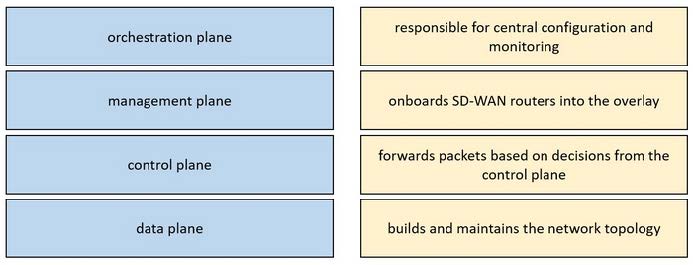
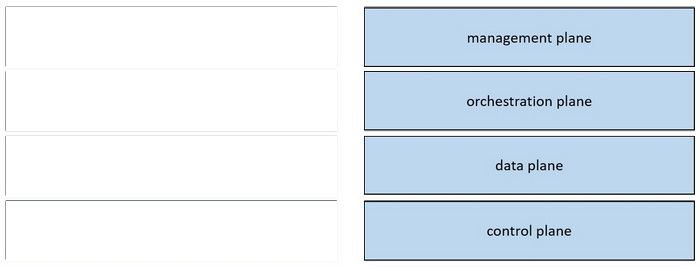
DRAG DROP
Drag and drop the Cisco SD-WAN components from the left onto their definitions on the right.
Select and Place:
Correct Answer:
Question 13:
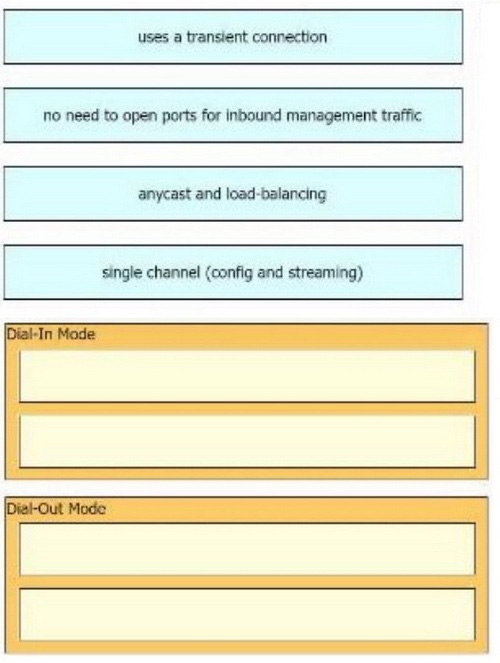
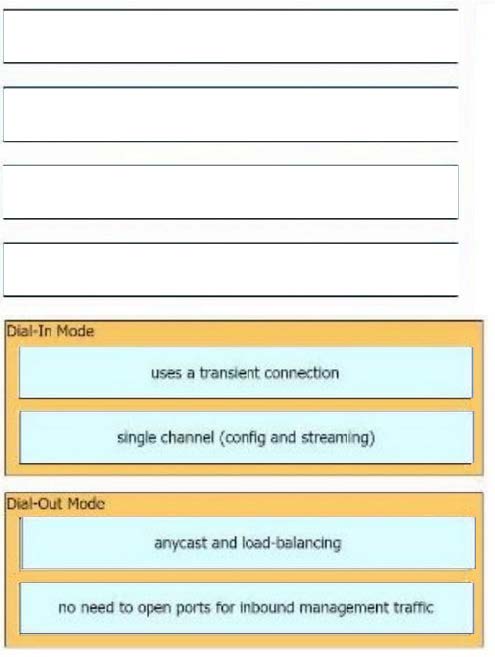
DRAG DROP
Drag and drop the model-driven telemetry considerations from the left onto the modes they apply to on the right.
Select and Place:
Correct Answer:
Question 14:
An engineer must design a management network that enables SSH, NTP, FTP, and SNMP over the production network. The design requires the management of routers and switches that exist across different networks. Which feature must the design include?
A. Management Plane Protection
B. dedicated management console connection per device
C. terminal server
D. dedicated management VRF connection per device
Correct Answer: D
Question 15:
An engineer is creating a design to enable IPv6 to run on an existing IPv4 IS-IS network. The IPv4 and IPv6 topologies will match exactly, and the engineer plans to use the same IS-IS router levels for each protocol per interface. Which IS-IS design is required?
A. multi topology without enabling transition feature
B. multi topology with transition feature enabled
C. single topology without enabling transition feature
D. single topology with transition feature enabled
Correct Answer: C
Explanation:
C. single topology without enabling transition feature
In a single topology design, both IPv4 and IPv6 addresses can be carried within the same IS-IS domain without creating separate topologies. IS-IS,
being a Layer 2 protocol, can natively support both IPv4 and IPv6. By utilizing a single topology design without any transition feature, the engineer
can enable IPv6 on the existing IPv4 IS-IS network with the same router levels for each protocol per interface, while still maintaining a single,
integrated topology.
…
Practical Architecture Insights from Industry Experts
Real Project Knowledge
Many companies are still transitioning from traditional networks to cloud-integrated architectures. ENSLD design questions often reflect issues like route convergence, multi-cloud path selection, and redundancy patterns.
Core Principles of Cisco Architecture Thinking
Cisco emphasizes a design philosophy based on layering, modularity, and scalability. Understanding these pillars makes it easier to determine the correct answer in complex scenarios.
How Experts Analyze ENSLD Questions
Experts evaluate constraints → eliminate infeasible options → select the most scalable and secure design. This approach is more effective than memorizing answers.
Recommended Study Path for Cisco 300-420 Candidates
Roadmap from Beginner to Advanced
Start with network fundamentals → enterprise architecture → routing strategy → practical scenarios → simulation practice
Most Efficient Study Order for 2025
- Review the official blueprint
- Study by domain
- Reinforce with labs
- Practice scenario-based questions
- Review structured summaries (e.g., Leads4pass)
Exam Strategy
- Understand context deeply
- Avoid memorizing answers blindly
- For scenario questions, prioritize scalability and security
Conclusion
The Cisco 300-420 ENSLD exam in 2025 continues evolving toward true enterprise design scenarios. Up-to-date study materials are essential for success. Whether you are at the beginning or final review stage, ensure that your content matches the latest blueprint and uses scenario-based understanding. By combining official documentation with high-quality structured resources, you can learn Cisco’s architectural mindset more efficiently and significantly improve your passing chances.
FAQs
1. Is the 300-420 exam significantly different in 2025?
Yes, with expanded automation and architecture-centric content.
2. Does 300-420 ENSLD require deep routing knowledge?
Yes, especially BGP policy and SD-WAN route selection.
3. What is the best starting point for 300-420 ENSLD prep?
Start with Cisco’s official blueprint, then use curated professional materials.
4. How long does 300-420 ENSLD preparation take?
Most candidates need 6–10 weeks depending on prior experience.
5. Should 350-401 ENCOR and 300-420 ENSLD be studied together?
Yes. Many foundational concepts overlap and complement each other.